Enneagram type 1 (also written Enneagram 1) is called The Reformer, also known as The Perfectionist. Here you will find a thorough description of type 1: core traits, basic fear, wings, love and relationships, stress and growth. In the Enneagram, type 1 belongs to the body centre along with types 8 and 9.
Characteristics
Enneagram type 1s are conscientious people who are concerned with how things can be done right and completely perfectly. They have a strong inner critic, which ensures that they constantly make an effort to live up to the norms and rules more than to do what they really want. This shows in their language, which is characterised by words of obligation such as should and ought to.
Type 1 enjoys doing a good job and focuses on details, order and structures.
Ones have clear definitions of what is right and wrong, for example setting their mouth neatly back in place after laughing or talking. Preferably with a little dismissive nod. They also have rules for what feelings are okay to show and what it's best to keep a lid on (e.g. anger, jealousy or shame). It shows in slightly tight body language and in the tension in the neck and jaw.
Contributes with
Ones have a good sense of order and high morals. They live by the motto "duty before pleasure", which means they put in a great effort and do not stop until the job is done.
Thrives best with
Ones thrive best with a clear framework and guidelines so they know what to measure themselves against in order to do the job properly. This means that clear procedures and an established agenda provide security and make everyday work easier.
Resources
- Persistent
- An eye for detail
- Completes tasks
Direction of stress
When ones are under pressure and feel insecure, they get in touch with too many feelings, which have also been tucked away, and they remember all the other times when things did not go well. The movement goes toward type 4, The Individualist.
Direction of security
When ones are on top form and feel resourceful and confident, they begin to get lots of ideas and like to plan events or dream about things they would one day like to do. The movement goes toward type 7, The Enthusiast.

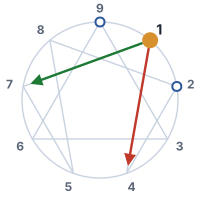
You may be Enneagram type 1 if you recognise the following
- You have an eye for how things could be done better.
- You have a strict inner critic that tells you what is right and wrong.
- You do a lot to avoid mistakes and misunderstandings.
- You have high moral standards.
- You value practical virtues such as hard work, honesty, effort and competence.
- When others get away lightly with what you do, you may well feel slightly indignant.
- You may be worried about having to make decisions, wondering whether it is the right choice.
- You have an intuitive feel for how perfect things could be.
- You feel an inner satisfaction at finishing something down to the last detail.
The subtypes of type 1
All nine types come in three subtypes, depending on which instinctual drive weighs heaviest: self-preservation, social or one-to-one. Two people with the same core type can seem surprisingly different, precisely because the subtype colours the entire expression.
The self-preservation type 1
The self-preservation type 1 turns the demands inwards and towards what is close at hand. Order in the home, control of the finances, details that add up. The worry about overlooking something drives the precision, and the anger is rarely spoken aloud — it turns into restless diligence. This is the most recognisably perfectionistic of the three, and also the one that carries the most tension in the body.
The social type 1
The social type 1 becomes the group's yardstick. The right way of doing things becomes something you represent rather than something you demand. There is a teacherly quality here, and a tendency to hold oneself slightly above the situation. The pitfall is unconsciously turning one's own standard into the universal one.
The one-to-one type 1
The one-to-one type 1 turns the urge to reform outwards, towards the people who matter. The ideal applies not only to oneself but to the other person as well, and that makes the engagement warm and demanding at the same time. This is the most outgoing and the most openly angry of the three subtypes.
Type 1 through the nine levels of development
The Enneagram describes not only which type you are, but how that type looks in different shapes. Riso-Hudson divide each type into nine levels of development, gathered into three bands: levels 1, 2 and 3 are the healthy ones, levels 4, 5 and 6 are the average ones, and levels 7, 8 and 9 are the unhealthy ones. You move between them over the course of a life, and often within a single day.
Below, the three bands for type 1 are described in outline. Riso-Hudson describe each of the nine levels in depth, and we work with that material on our courses, where you learn to recognise your own movements between the levels.
The healthy levels — 1, 2 and 3
At the healthy levels, type 1 lets go of the demand that reality be set straight, and discovers that judgement can be exercised without being judgemental. There is acceptance, proportion and a calm integrity. This is the type others turn to when something needs doing properly — not because it insists, but because it can.
The average levels — 4, 5 and 6
Here the ideal becomes a task. Type 1 organises, corrects and improves, and spends more energy on keeping order than on enjoying the result. The criticism is inward at first, audible later. This is where most people are most of the time, and also where the impatience with others begins to cost relationships.
The unhealthy levels — 7, 8 and 9
At the unhealthy levels the demand becomes relentless. Self-criticism loses all proportion, and the world is experienced as fundamentally wrong. A hardness can set in, towards oneself as much as towards others, along with a compulsive preoccupation with details that no longer relate to anything.
Your personal path of development
Ones' development is to get to know their feelings and discover that when the so-called wrong or negative feelings are accepted, it means they are not as dangerous as they previously seemed. When ones get to know them, they can let them go, and let go of the fixation on everything that is wrong. Instead they experience a state of serenity and clarity, which gives access to the particular aspect of essence: the state in which everything is perfectly in accordance with a higher order.

Frequently asked questions about Enneagram type 1
What characterises Enneagram type 1, The Reformer?
What is Enneagram type 1 also called?
What are Enneagram type 1's basic fear and basic desire?
What is Enneagram type 1 like in love and relationships?
What are type 1's wings, 1w9 and 1w2?
How do I know if I'm Enneagram type 1?
What is type 1's passion and essence?
How do you lead an Enneagram type 1?
How do you sell to an Enneagram type 1?
What are the subtypes of type 1?
Want to go deeper into type 1? On our test site 360indicator you will find the extended description of Enneagram type 1 with video, a diagram of the wings 9 and 2, and the movements towards type 4 under stress and type 7 in security. See also the overview of all nine Enneagram types.
Find your own type
Take the Enneagram test at 360indicator, or join our intro course and find your type with an experienced instructor.
Buy the premium testTake a free Enneagram test Take an Enneagram course See in-house courses See our Enneagram training programmesOpen courses are offered in Danish in Denmark. In-house courses can be delivered across Europe in Danish, English or Swedish.