Enneagram type 6 (also written Enneagram 6) is called The Skeptic, also known as The Loyalist. Here you will find a thorough description of type 6: core traits, basic fear, wings, love and relationships, stress and growth. In the Enneagram, type 6 belongs to the head centre along with types 5 and 7.
Characteristics
Enneagram type 6s are shrewd, loyal people who are eager to analyse and consider the pros and cons.
They focus on what can go wrong, so as to guard against it. They often have several contingency plans ready and always have a plaster in their bag or an umbrella in the boot in case it should start to rain.
Sixes have a knack for always being able to take the opposite view to the one others take, in order to balance or counterbalance. It becomes visible in their often asymmetrical posture. Type six often has a slightly dry humour. They are experts in irony and are also fond of self-mockery.
Contributes with
Enneagram type 6s are good analysts and work on the situation or topic until all angles have been thought through. They have a special ability to read between the lines, and that means that they quickly detect hidden agendas.
Thrives best with
Enneagram type 6s like to be appreciated for their analytical skills and thrive in an environment where there is room for healthy scepticism.
Resources
- Balance
- Analyses
- Sees many angles
- Irony and Humour
Direction of stress
When Enneagram type 6s are under pressure and feel threatened, they become more active and action-oriented and get a lot done, because they receive recognition, but they become frustrated at not having time to think things through properly. The movement goes toward type 3, The Achiever.
Direction of security
When Enneagram type 6s are confident and trusting, it becomes easier for them to relax and calm the mind. They focus on the positive and enjoy the whole. The movement goes toward type 9, The Mediator.

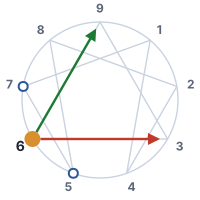
You may be Enneagram type 6 if you recognise the following
- You often analyse all the consequences before making a decision.
- You often take the opposite position to balance or counterbalance
- You often imagine what could go wrong, in order to guard yourself against it.
- Authorities are an issue in your life. Either you believe in them or it makes you rebel against them.
- You identify with the cause and fight for the weak in society.
- You often catch yourself wondering whether your decision really was the right one.
- You look for the hidden agendas and motives that may affect cooperation.
- You are very loyal and supportive of your friends and/or family.
The subtypes of type 6
All nine types come in three subtypes, depending on which instinctual drive weighs heaviest: self-preservation, social or one-to-one. Two people with the same core type can seem surprisingly different, precisely because the subtype colours the entire expression.
The self-preservation type 6
The self-preservation type 6 creates security through relationships. It is warm, welcoming and good at building alliances, and it seeks protection in being liked. The doubt rarely turns into confrontation. The pitfall is making itself too small in order to keep the peace.
The social type 6
The social type 6 finds its footing in the system: the rules, the framework, whatever has been agreed. It is loyal and dutiful and knows exactly where the boundaries lie. The pitfall is letting the external point of reference replace its own judgement.
The one-to-one type 6
The one-to-one type 6 moves towards the fear rather than away from it. This is the counterphobic variant: challenging, direct and at times provocative, because strength feels safer than caution. The pitfall is that the courage becomes an armour concealing the doubt that is still there.
Type 6 through the nine levels of development
The Enneagram describes not only which type you are, but how that type looks in different shapes. Riso-Hudson divide each type into nine levels of development, gathered into three bands: levels 1, 2 and 3 are the healthy ones, levels 4, 5 and 6 are the average ones, and levels 7, 8 and 9 are the unhealthy ones. You move between them over the course of a life, and often within a single day.
Below, the three bands for type 6 are described in outline. Riso-Hudson describe each of the nine levels in depth, and we work with that material on our courses, where you learn to recognise your own movements between the levels.
The healthy levels — 1, 2 and 3
At the healthy levels, type 6 finds the authority within. It can trust its own judgement without needing it confirmed, and loyalty becomes a choice rather than a need. This is the type others most want beside them when it really matters, because the courage is genuine and not rigid.
The average levels — 4, 5 and 6
Here the energy goes into anticipating what might go wrong. Type 6 tests other people's intentions, seeks reassurance, and alternates between leaning on something and pushing back against it. The doubt becomes a habit, and decisions grow heavy because both options can be defended.
The unhealthy levels — 7, 8 and 9
At the unhealthy levels the mistrust takes over. The type sees hostility where there is none and reacts either with submission or with fierce resistance. The anxiety can run so high that action comes before thought — and it is often that action which confirms the fear.
Your personal path of development
Enneagram type 6's path of development goes through letting go of the fixation on doubting themselves as well as others. This is done by developing confidence and thereby daring to do the opposite of what the mind says. In this way sixes experience contact with the particular aspect of essence in which there is a belief that everything will go well, and that there is an overall positive intention behind everything that happens.

Frequently asked questions about Enneagram type 6
What characterises Enneagram type 6, The Skeptic?
What is Enneagram type 6 also called?
What are Enneagram type 6's basic fear and basic desire?
What is Enneagram type 6 like in love and relationships?
What are type 6's wings, 6w5 and 6w7?
How do I know if I'm Enneagram type 6?
What is type 6's passion and essence?
How do you lead an Enneagram type 6?
How do you sell to an Enneagram type 6?
What are the subtypes of type 6?
Want to go deeper into type 6? On our test site 360indicator you will find the extended description of Enneagram type 6 with video, a diagram of the wings 5 and 7, and the movements towards type 3 under stress and type 9 in security. See also the overview of all nine Enneagram types.
Find your own type
Take the Enneagram test at 360indicator, or join our intro course and find your type with an experienced instructor.
Buy the premium testTake a free Enneagram test Take an Enneagram course See in-house courses See our Enneagram training programmesOpen courses are offered in Danish in Denmark. In-house courses can be delivered across Europe in Danish, English or Swedish.