Enneagram type 7 (also written Enneagram 7) is called The Enthusiast, also known as The Adventurer. Here you will find a thorough description of type 7: core traits, basic fear, wings, love and relationships, stress and growth. In the Enneagram, type 7 belongs to the head centre along with types 5 and 6.
Characteristics
Enneagram type 7s are optimistic and imaginative people who are preoccupied with what experiences the future may bring. They are motivated by all that is new and exciting, and to develop ideas that do not necessarily have to be realised.
For sevens, life must be fun and interesting. They are therefore experts at giving every experience a positive slant, and they are quick to see opportunities for new adventures. Sevens often have a youthful appearance, because troubles and burdens tend to pass their attention by.
Enneagram type 7s do not like to be locked into contracts and procedures; it is important for them to have a choice at all times and to be able to move on. This shows in their lively, light body language.
Contributes with
Enneagram type 7s are very enthusiastic and always have a good idea or a plan up their sleeve. They are good at seeing the positive in a situation and infect others with their optimism and commitment.
Thrives best with
Enneagram type 7s thrive on development and options. They like environments without fixed agendas, where the day changes direction and new initiatives are created.
Resources
- Upbeat
- Opportunity-oriented
- Good motivators
- Happy
Direction of stress
When Enneagram type 7s are under pressure and feel restricted, they lose their overview and experience "tunnel vision", where they only have an eye for detail. The movement goes toward type 1, The Reformer.
Direction of security
When Enneagram type 7s are resourceful and at ease with themselves, they become more introspective and thoughtful. They withdraw and enjoy reflecting. The movement goes toward type 5, The Investigator.

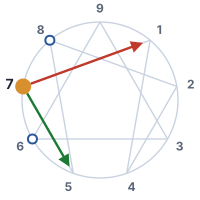
You may be Enneagram type 7 if you recognise the following
- You are easily fascinated by people, experiences and everything new.
- You look for stimulation and can at times manage almost without sleep.
- You have a desire to stay in a good mood, and you are good at lifting the mood of others.
- You always have many options, and you always make sure not to be limited.
- You can marvel at people who experience life as problematic and heavy.
- You use your charm as a first line of defence and avoid conflict by talking your way out of it.
- You have an incredible ability to put ideas and topics together in a new way.
- Your head is full of ideas and plans, and you are fine with not getting round to them all.
The subtypes of type 7
All nine types come in three subtypes, depending on which instinctual drive weighs heaviest: self-preservation, social or one-to-one. Two people with the same core type can seem surprisingly different, precisely because the subtype colours the entire expression.
The self-preservation type 7
The self-preservation type 7 is the practical networker. It creates opportunities for itself, collects good connections and makes sure there is always somewhere comfortable to land. There is a down-to-earth inventiveness here. The pitfall is that the comfort becomes an end in itself, and you never get round to what you actually wanted.
The social type 7
The social type 7 puts its own gratification on hold for something larger. It wants to contribute, to be useful and to be seen as a good person, and it can postpone a great deal for a cause. The pitfall is that the idealism becomes another kind of escape — you get out of facing yourself by living for others.
The one-to-one type 7
The one-to-one type 7 lives in the possible. It falls in love with ideas, people and pictures of the future, and describes them so vividly that others believe in them. The pitfall is that the fascination fades once reality arrives, and that there is always something more promising waiting up ahead.
Type 7 through the nine levels of development
The Enneagram describes not only which type you are, but how that type looks in different shapes. Riso-Hudson divide each type into nine levels of development, gathered into three bands: levels 1, 2 and 3 are the healthy ones, levels 4, 5 and 6 are the average ones, and levels 7, 8 and 9 are the unhealthy ones. You move between them over the course of a life, and often within a single day.
Below, the three bands for type 7 are described in outline. Riso-Hudson describe each of the nine levels in depth, and we work with that material on our courses, where you learn to recognise your own movements between the levels.
The healthy levels — 1, 2 and 3
At the healthy levels, type 7 becomes present in what it already has. The joy grows deep rather than wide, and the gift for seeing possibilities is spent on something particular rather than on everything. This is where the type's gratitude and appetite for life rub off on others without being an escape.
The average levels — 4, 5 and 6
Here the planning of the next thing becomes more important than the present one. Type 7 keeps many balls in the air, says yes to too much and moves on as soon as something turns dull or difficult. The restlessness looks like energy, but it is also a way of keeping discomfort at a distance.
The unhealthy levels — 7, 8 and 9
At the unhealthy levels the escape turns desperate. The impulses take over, the consumption rises — of experiences, of impressions or of substances — and the type can become reckless towards anyone who tries to slow it down. Beneath the surface lies the anxiety the speed was meant to keep away.
Your personal path of development
Enneagram type 7's path of development goes through letting go of the fixation on making plans and thinking about future prospects, and instead being present in the moment, whatever it contains. In this way they develop the special ability to relate soberly to reality, and sevens experience contact with the particular aspect of essence in which there is an almost supernatural sensation of the present moment, a source of endless joy and insight.

Frequently asked questions about Enneagram type 7
What characterises Enneagram type 7, The Enthusiast?
What is Enneagram type 7 also called?
What are Enneagram type 7's basic fear and basic desire?
What is Enneagram type 7 like in love and relationships?
What are type 7's wings, 7w6 and 7w8?
How do I know if I'm Enneagram type 7?
What is type 7's passion and essence?
How do you lead an Enneagram type 7?
How do you sell to an Enneagram type 7?
What are the subtypes of type 7?
Want to go deeper into type 7? On our test site 360indicator you will find the extended description of Enneagram type 7 with video, a diagram of the wings 6 and 8, and the movements towards type 1 under stress and type 5 in security. See also the overview of all nine Enneagram types.
Find your own type
Take the Enneagram test at 360indicator, or join our intro course and find your type with an experienced instructor.
Buy the premium testTake a free Enneagram test Take an Enneagram course See in-house courses See our Enneagram training programmesOpen courses are offered in Danish in Denmark. In-house courses can be delivered across Europe in Danish, English or Swedish.