Enneagram type 2 (also written Enneagram 2) is called The Helper, also known as The Giver. Here you will find a thorough description of type 2: core traits, basic fear, wings, love and relationships, stress and growth. In the Enneagram, type 2 belongs to the heart centre along with types 3 and 4.
Characteristics
Enneagram type 2s are welcoming and often smiling people who want to be there for others, to help and to support. They have a strong ability to empathise with others' experiences and can quickly pick up what they need.
Enneagram type 2s seek recognition for their helpfulness and are so focused on the needs of others that they often find it difficult to know what they themselves want and need.
This makes it difficult for twos to receive, and in general to express their own needs. They may occasionally feel that they have to give and do not get enough back. Twos are often optimistic, extrovert people who seek contact with others, quickly make eye contact and hit it off.
Contributes with
Type 2 is good at creating relationships. They are likeable and sympathetic to others and it is often they who make sure that people feel comfortable, by paying attention to the needs of others.
Thrives best with
Enneagram type 2s thrive on working with people and their development. They often choose service sectors where communication with others is of great importance and where they can use their abilities to see others' potential.
Resources
- Creating relationships
- Positive
- Spotting others' resources
- Charming
Direction of stress
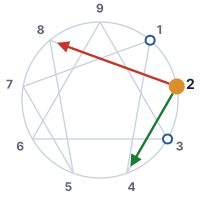
When Enneagram type 2s feel pressured or uncomfortable they gain access to anger. They are suddenly no longer in doubt about what they want and what should be done, and take control in a tough and robust way, which often surprises those around them. The movement goes toward type 8, The Challenger.
Direction of security
When Enneagram type 2s are confident and feel resourceful they become more creative and find it easier to get in touch with their own feelings and needs. The movement goes toward type 4, The Individualist.
You may be Enneagram type 2 if you recognise the following
- You like to find exactly what is needed for others to get on with their lives.
- You really have the ability to be empathetic.
- You are brilliant at spotting other people's abilities and resources.
- You are proud that you are needed and that you are a key person in the lives of others.
- You find it difficult to ask for help yourself and to express your own needs.
- You often adapt in order to please others and may therefore find that you have many different roles.
- You experience a strange inner emptiness when there is too much attention on you.
- You sometimes ask yourself: "Who am I?"
- You may feel limited by having to constantly give to others and have a great desire for freedom.
The subtypes of type 2
All nine types come in three subtypes, depending on which instinctual drive weighs heaviest: self-preservation, social or one-to-one. Two people with the same core type can seem surprisingly different, precisely because the subtype colours the entire expression.
The self-preservation type 2
The self-preservation type 2 has a more reticent kind of helpfulness. There is something immediate and inviting about it that makes other people want to look after it in return — the care becomes mutual rather than one-sided. The pitfall is that the needs are not spoken but shown, so the disappointment comes as a surprise to both parties.
The social type 2
The social type 2 helps at the level of the group. It attaches itself to those with influence and gains significance by being useful to the whole. There is genuine generosity here, but also an ambition the type itself finds hard to see. The pitfall is mistaking influence for closeness.
The one-to-one type 2
The one-to-one type 2 gathers all its attention on the individual person. There is an intensity and a charm that is hard to resist, and a wish to become indispensable to that one person. This is the most openly needy of the three, and the one that feels rejection most keenly.
Type 2 through the nine levels of development
The Enneagram describes not only which type you are, but how that type looks in different shapes. Riso-Hudson divide each type into nine levels of development, gathered into three bands: levels 1, 2 and 3 are the healthy ones, levels 4, 5 and 6 are the average ones, and levels 7, 8 and 9 are the unhealthy ones. You move between them over the course of a life, and often within a single day.
Below, the three bands for type 2 are described in outline. Riso-Hudson describe each of the nine levels in depth, and we work with that material on our courses, where you learn to recognise your own movements between the levels.
The healthy levels — 1, 2 and 3
At the healthy levels, type 2 gives without keeping score. The care becomes free, because it is no longer needed to secure its own place. The type can feel its own needs and say them out loud, and that is precisely what makes its generosity credible rather than binding.
The average levels — 4, 5 and 6
Here the helping becomes a strategy. Type 2 reads other people's needs faster than its own and makes itself necessary. An invisible ledger builds up that nobody agreed to, and it only becomes visible on the day the gratitude fails to arrive. This is where most people are most of the time.
The unhealthy levels — 7, 8 and 9
At the unhealthy levels the need to be loved becomes all-consuming. The helping turns intrusive, and when it is not returned, the sense of grievance follows. The type can become manipulative without recognising itself as such, and the body is often the first to send the bill.
Your personal path of development
Enneagram type 2's development is to let go of the fixation on being recognised for what they do. Instead, twos can learn to rely on themselves and to ask for and receive help from others. This gives access to the two's special ability, humility about the fact that others can help too. Through this, twos experience contact with the particular aspect of essence: a state in which there is freedom to give or not to give, and freedom to be themselves and accept help when they need it.

Frequently asked questions about Enneagram type 2
What characterises Enneagram type 2, The Helper?
What is Enneagram type 2 also called?
What are Enneagram type 2's basic fear and basic desire?
What is Enneagram type 2 like in love and relationships?
What are type 2's wings, 2w1 and 2w3?
How do I know if I'm Enneagram type 2?
What is type 2's passion and essence?
How do you lead an Enneagram type 2?
How do you sell to an Enneagram type 2?
What are the subtypes of type 2?
Want to go deeper into type 2? On our test site 360indicator you will find the extended description of Enneagram type 2 with video, a diagram of the wings 1 and 3, and the movements towards type 8 under stress and type 4 in security. See also the overview of all nine Enneagram types.
Find your own type
Take the Enneagram test at 360indicator, or join our intro course and find your type with an experienced instructor.
Buy the premium testTake a free Enneagram test Take an Enneagram course See in-house courses See our Enneagram training programmesOpen courses are offered in Danish in Denmark. In-house courses can be delivered across Europe in Danish, English or Swedish.