Enneagram type 4 (also written Enneagram 4) is called The Individualist, also known as The Romantic. Here you will find a thorough description of type 4: core traits, basic fear, wings, love and relationships, stress and growth. In the Enneagram, type 4 belongs to the heart centre along with types 2 and 3.
Characteristics
Enneagram type 4s are emotional, profound people for whom it is important that life is intense. They therefore have an ability to amplify their impressions of experiences, so that they can really feel that they are alive.
Fours can swing in mood many times over the course of a day and they know all the nuances of emotions ranging from ecstatic happiness to deep sadness and depression. They often focus on what is lacking, and that gives them the ability to give their surroundings a unique and personal touch.
For Enneagram type 4s, the important thing in life is that there is something special, and they use their creative skills to turn the general and everyday into something unique. The need to be special may show in a taste for clothes with special touches, and fours often have a recognisable laugh.
Contributes with
Enneagram type 4s are good at holding other people's feelings, because they know feelings in many forms. They use their aesthetic sense to put the icing on the cake whenever they get the chance to put a personal stamp on what they are doing.
Thrives best with
Enneagram type 4s thrive in environments where there is room for individual solutions and where they are appreciated for their special ability to spot what is missing.
Resources
- Creative
- Aesthetic sense
- Holds all emotions
- Attention to the unique
Direction of stress
When Enneagram type 4s are under pressure and feel insecure, they lose touch with their emotions and focus on what they can do for others in order to become popular again. The movement goes toward type 2, The Helper.
Direction of security
When Enneagram type 4s are safe and feel resourceful, they find it easier to stay focused on the task and get things done in the right way. They pay attention to the unique details and to perfect aesthetics. The movement goes toward type 1, The Reformer.

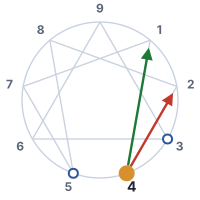
You may be Enneagram type 4 if you recognise the following
- You amplify experiences in your inner world in order to feel the intensity.
- Close relationships and close ties to other people are important to you.
- You have a tendency to yearn for something you think is missing right now.
- You have good taste and a liking for the extraordinary, for being special.
- You are often concerned with how others perceive you, and you try to read their thoughts about you.
- You feel that you are living through intense experiences and creative expression.
- You reject the general, everyday life and routines.
- You make normal life more exciting with fantasies and dramatic inner images.
- You experience great depth in your emotional life, and you are not frightened by other people's feelings in a crisis.
The subtypes of type 4
All nine types come in three subtypes, depending on which instinctual drive weighs heaviest: self-preservation, social or one-to-one. Two people with the same core type can seem surprisingly different, precisely because the subtype colours the entire expression.
The self-preservation type 4
The self-preservation type 4 carries its sense of loss without complaining. It endures, works hard and does something about its longing instead of talking about it. From the outside it can seem robust and almost unremarkable, and it is often the one that surprises others most. The pitfall is that the pain is not shared until it has grown too large.
The social type 4
The social type 4 measures itself against the group and finds itself wanting. There is a finely tuned awareness of where one stands in relation to others, and a tendency to take up the role of the person who sees things from the outside. The pitfall is shame turning into an identity.
The one-to-one type 4
The one-to-one type 4 is the most expressive and the most demanding. It competes — not to be the best, but to be the one who feels most deeply and is seen most clearly. There is an intensity that both attracts and burns, and a low threshold for being overlooked.
Type 4 through the nine levels of development
The Enneagram describes not only which type you are, but how that type looks in different shapes. Riso-Hudson divide each type into nine levels of development, gathered into three bands: levels 1, 2 and 3 are the healthy ones, levels 4, 5 and 6 are the average ones, and levels 7, 8 and 9 are the unhealthy ones. You move between them over the course of a life, and often within a single day.
Below, the three bands for type 4 are described in outline. Riso-Hudson describe each of the nine levels in depth, and we work with that material on our courses, where you learn to recognise your own movements between the levels.
The healthy levels — 1, 2 and 3
At the healthy levels, type 4 stops searching for itself and begins to create. The sensitivity becomes a gift rather than a burden, and the capacity to hold what is difficult makes the type the one others come to with what they cannot say anywhere else. There is a calm that does not need to be special.
The average levels — 4, 5 and 6
Here the identity becomes a project. Type 4 cultivates whatever sets it apart from others and constantly compares itself with those who seem to have got what it lacks. The moods are allowed to decide, and the practical business of everyday life becomes something to get to afterwards.
The unhealthy levels — 7, 8 and 9
At the unhealthy levels the longing turns inwards as self-contempt. The type withdraws from the very people it needs most, and it can become hard to distinguish between feeling something and being what you feel. A self-destructive side can emerge, where the pain becomes the only thing that feels real.
Your personal path of development
Enneagram type 4's path of development goes through letting go of the fixation on everything that is missing and everything that is wrong, and instead using their special ability to experience everything as equal. By focusing on what is present in the moment and seeing it as being just as good as what is missing, the four comes to leave their suffering behind and make contact with the particular aspect of essence: a state of being connected to the whole, in which everything and everyone is connected in a larger whole.

Frequently asked questions about Enneagram type 4
What characterises Enneagram type 4, The Individualist?
What is Enneagram type 4 also called?
What are Enneagram type 4's basic fear and basic desire?
What is Enneagram type 4 like in love and relationships?
What are type 4's wings, 4w3 and 4w5?
How do I know if I'm Enneagram type 4?
What is type 4's passion and essence?
How do you lead an Enneagram type 4?
How do you sell to an Enneagram type 4?
What are the subtypes of type 4?
Want to go deeper into type 4? On our test site 360indicator you will find the extended description of Enneagram type 4 with video, a diagram of the wings 3 and 5, and the movements towards type 2 under stress and type 1 in security. See also the overview of all nine Enneagram types.
Find your own type
Take the Enneagram test at 360indicator, or join our intro course and find your type with an experienced instructor.
Buy the premium testTake a free Enneagram test Take an Enneagram course See in-house courses See our Enneagram training programmesOpen courses are offered in Danish in Denmark. In-house courses can be delivered across Europe in Danish, English or Swedish.